

THE SHORT ANSWER
Can You Have a Hair Transplant Without Shaving Your Head?
Unshaven FUE · London

Yes, for some patients
Often, yes. Many suitable patients can have FUE without shaving the whole head.
What "unshaven" means in practice varies from one patient to the next. It depends on your hair length, the area being treated, the density and character of your donor hair, and how many grafts are needed.
For some patients nothing is shaved at all. For others, a small, concealed area is trimmed so that extraction can be carried out accurately
Fully unshaven
Donor and recipient hair are left at their existing length. Follicles are extracted individually from between the surrounding hairs. The most discreet option, and the most time-intensive, so it generally suits smaller sessions.
Concealed donor shave
A band of donor hair is trimmed short beneath longer hair at the back of the head. Once the hair is let down, the longer layer falls over the trimmed area and covers it.
Window or line shave
Small windows or narrow lines are trimmed within the donor area, spread so that surrounding hair covers each one. Useful where more grafts are needed than a fully unshaven session allows.
Recipient hair preserved
Existing hair in and around the treated area is kept at length, and grafts are placed between existing hairs. Where clinically appropriate, this can be combined with any of the donor approaches.
THE SURGICAL PRIORITY
The aim is not simply to avoid shaving. It is to choose the least disruptive approach that still allows precise, safe transplantation.
PLANNED AROUND YOUR LIFE
How Discreet Does Your Hair Transplant Need to Be?
Every patient has different reasons for wanting discretion. Knowing yours helps decide which approach, and how much shaving, is right for you

Return to work with minimal disruption
For professional and client-facing roles, the timing of surgery, the area treated and how much donor hair is trimmed can all be planned to reduce time away and questions on your return.

Keep your existing hairstyle
If you wear your hair at medium or longer length, a full shave can mean months of growing it back. Unshaven approaches aim to leave your style largely as it is before, during and after surgery.

Keep your treatment private
Donor access, recipient placement and your recovery are planned together, so that what others might see in the first days is kept to a minimum.
How Much Shaving is Needed?
The donor area may be shaved in a zone concealed by longer hair, prepared in multiple narrow lines, or blended into
a short haircut. The appropriate pattern depends on your donor hair, hairstyle and graft requirements.
UNSHAVEN FUE OPTIONS FOR MEN
Unshaven FUE for Men:
Three Ways to Prepare the Donor Area
Most men who ask about Unshaven FUE want the same thing: to go back to work without a freshly shaved head inviting questions. How that is achieved depends less on the name of the technique and more on how you wear your hair now.
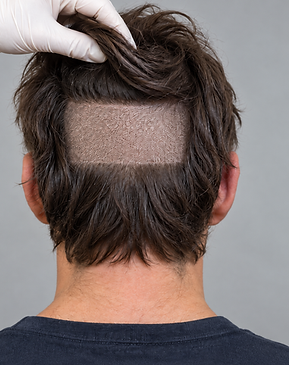
Window Shave
Concealed Donor Zone
A band at the back of the scalp is trimmed short, while the longer hair above it is left untouched. When your hair falls naturally, it covers the trimmed band completely.
OFTEN SUITS:
Men with longer hair at the back of the head, and hairline or temple work needing a moderate number of grafts.
KEEP IN MIND:
The band shows if the hair is lifted or cut short, and takes a few weeks to grow back to match.
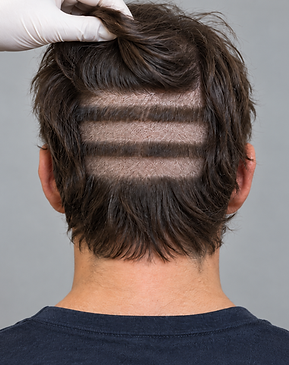
Line Shave
Multiple Narrow Lines
Several thin strips are prepared across the donor area, each separated by longer hair. Spreading extraction this way protects donor density and keeps each strip easy to hide.
OFTEN SUITS:
Medium-length hair, and patients who need more grafts than one concealed zone can safely provide.
KEEP IN MIND:
The lines are well hidden with hair dry and styled, but can show when the hair is wet or combed through.
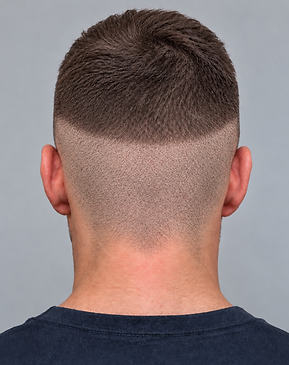
Marine Shave
Blended Into a Short Haircut
The back and sides are cut short in a fade or taper, and the hair on top is left at full length. To anyone else, it looks like a new haircut rather than a procedure.
OFTEN SUITS:
Men who already wear short back and sides, and larger sessions where wider donor access matters.
KEEP IN MIND:
The back looks different for a few weeks. The top, including a treated hairline, keeps its length.
The right pattern for you depends on your donor density, how many grafts your hairline, temples or crown need, and how you style your hair. Dr Feyroza will recommend one at consultation and explain why.
HEALING STAGES FOR MEN
What Will People Actually See As You Heal?
For most men the treated area is the hairline or temples. How visible the donor area is depends on the shaving pattern above: a concealed zone or narrow lines stay under longer hair, while a short back and sides shows the donor area more openly for the first week. Healing varies between patients, and your aftercare instructions come first.

SURGERY DAY
Immediately after surgery
Small graft sites are visible between your existing hairs. The area looks red and slightly swollen. This settles within a few days.

DAYS 1 TO 3
Redness, small crusts and possible swelling
Graft sites develop small crusts. The area may look redder and feel tight. Mild swelling can occur, especially at the forehead. Your existing hair helps cover the area.

DAYS 4 TO 7
Swelling settles, crusts begin to soften
Crusts become darker and drier. This is a normal part of healing. The area may feel a little tight or itchy. You can continue with light daily activities.

DAYS 7 TO 10
Most crusts have cleared
Most crusts start to shed naturally. Redness reduces significantly. The recipient area looks less noticeable and blends better with your existing hair.

AROUND 2 WEEKS
Close to your usual appearance
The recipient area is well healed with no visible crusts. Any remaining mild redness is easily hidden by your existing hair. Most patients can confidently return to work and normal social activities at this stage.
UNSHAVEN FUE OPTIONS FOR WOMEN
Unshaven FUE for Women: Keeping Your Length
For many women, the thought of shaving is the reason a hair transplant never goes further than an online search. With longer hair, a full shave is rarely needed. The prepared area can sit beneath the upper layers of your hair, and your parting and style stay as they are.

Window Shave
Concealed donor zone
A zone hidden beneath your hair
A discreet section at the back of the scalp is trimmed underneath the upper layers of your hair. With your hair worn down, nothing is visible.
OFTEN SUITS:
Hairline lowering, temple recession and moderate graft numbers.
KEEP IN MIND:
High ponytails and tight updos are best avoided for a few weeks while the area grows back.

Line Shave
Multiple concealed lines
Narrow lines between the layers
Thin lines are prepared between layers of long hair, spreading extraction widely to protect density in an area that matters for any future treatment.
OFTEN SUITS:
Women needing more grafts, or with finer donor hair where extraction should be spread over a wider area.
KEEP IN MIND:
The lines stay hidden with your hair down and blend in as the hair regrows.

Unshaven Recipient
Your parting and hairline kept at length
In the treated area, existing hair
is not shaved. Grafts are placed between the hairs along the hairline, temples or a widened parting, so your style looks the same the day after.
OFTEN SUITS:
A widened central parting, temple thinning and defined areas of reduced density.
KEEP IN MIND:
Some redness along a parting may show in the first week. A side parting or softer styling helps.
Illustrative generated images of donor preparation, not clinical patient photographs.
Hair loss in women has many possible causes, including genetic, hormonal and medical factors. Before any transplant is planned, the cause of your hair loss, whether it has stabilised and the strength of your donor area are assessed. If a transplant is not the right step for you, you will be told, and why.
Which approach is suitable?
Concealed shaving may suit selected smaller graft sessions. The donor area needed depends on your graft requirements, donor density and hair length, and is confirmed after assessment.
What happens after treatment?
HEALING & RECOVERY FOR WOMEN ↓
HEALING STAGES FOR WOMEN
What Will People Actually See As You Heal?
For women the treated area is usually the hairline, temples or a widened parting. Because the donor area sits beneath long hair, it stays hidden throughout. The part that needs most care is the parting or hairline itself. Keep your existing hair length and style. Small incisions are made between your natural hairs. Typical appearance over the first 2 weeks. Healing varies between patients, and your aftercare instructions come first.

SURGERY DAY
Hair down, parting in place
TREATED AREA:
Grafts sit between your existing hairs along the hairline, temples or parting, each with a small spot of dried blood. A parting line looks pink.
DONOR AREA:
Pinpoint marks within the trimmed zone. Hidden when your hair is worn down.

DAYS 1 TO 3
Fine crusts along the parting or hairline
TREATED AREA:
Small crusts form around each graft. A side parting or loose styling hides most of them. The forehead may swell after hairline work.
DONOR AREA:
Small crusts form beneath your hair and may feel tender.
_edited.jpg)
DAYS 4 TO 7
Gentle washing lifts the crusts
TREATED AREA:
The crusts soften and lift with your washing routine. They should not be picked or brushed over, and long hair is washed carefully so it does not tangle around the grafts.
DONOR AREA:
Most donor crusts have cleared.

DAYS 7 TO 10
Crusts cleared, redness fading
TREATED AREA:
Most crusts have gone. Some pinkness along the parting or hairline remains, more visible on fair skin, and is usually concealed by styling.
DONOR AREA:
The marks have faded and short regrowth sits beneath the longer hair.
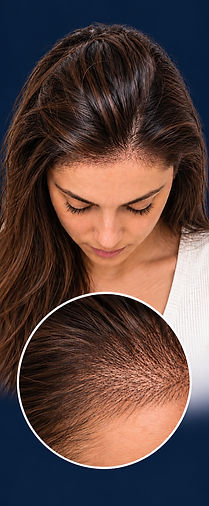
AROUND 2 WEEKS
Back to your usual styling
TREATED AREA:
Your usual parting and gentle styling are generally possible. Pinkness fades over the following weeks, and transplanted hairs commonly shed between weeks 2 and 6.
DONOR AREA:
Regrowth continues under the upper layers and blends in.
AFTER YOUR PROCEDURE
When Can I Return to Work After Unshaven FUE?
It depends on the area treated, how much swelling you have, your hair length and the kind of work you do. Your date is planned with you at consultation.
WORKING FROM HOME
Many patients resume desk work within a few days, once they feel comfortable. Video calls are usually easiest after swelling has settled.
MEETINGS
Close, face-to-face contact is best planned for once swelling has gone and most crusts have cleared, commonly around 7 to 10 days.
OFFICE WORK
A return after around a week is often practical, with longer hair covering the treated areas and crusts beginning to clear.
CLIENT-FACING ROLES
Allowing 10 days to 2 weeks gives the most margin. Surgery can be timed around holidays or quieter periods at work.
YOUR NEXT STEP
You Should Not Have to Choose Between Your Hair and Your Privacy
Many patients put off treatment for years because they could not face shaving their head, or explaining it at work. Send a few photographs of your hair from the front, top and back. Dr Feyroza will tell you honestly whether Unshaven FUE is suitable, which shaving pattern would work for you, and what others are likely to notice.
THE PROCEDURE
THE PROCEDURE
How Does Unshaven FUE Work?
The most discreet technique is not automatically the most appropriate technique. Selection depends on donor characteristics, graft requirements, recipient area, hairstyle and patient priorities.
Unshaven FUE follows the same four stages as standard FUE. The difference is in how each stage is planned and carried out around your existing hair, so that extraction and placement stay precise while your hairstyle is preserved.
01
Consultation & candidacy assessment
Your hair loss, donor area, hair characteristics and priorities are assessed to confirm whether an unshaven approach is appropriate.
02
Hairline, donor & discretion planning
The hairline or treatment area is designed, graft numbers are set, and the donor approach is chosen around how discreet you need to be.
03
Follicular unit extraction
Follicles are extracted individually under local anaesthetic, from between existing hairs or from a concealed trimmed area, spread to protect donor density.
04
Recipient sites & graft placement
Recipient sites are created between your existing hairs, matching natural angle and direction, and grafts are placed with care not to disturb the surrounding hair.

SURGEON-LED UNSHAVEN FUE
Your Treatment is Planned Around You, Not a Standard Package
Unshaven FUE is slower and more exacting than standard FUE. Every extraction and every graft is placed between hairs that are staying where they are. It depends on the judgement of the person holding the instruments, which is why one surgeon leads your care from the first assessment to your final review.
"Unshaven FUE takes longer and asks for more precision. I would rather plan for that honestly than promise it suits everyone."
DR FEYROZA MUSTAEVA
Who you see at each stage
The same doctor at every step of your treatment, from the first assessment to your final review.
01 · ASSESSMENT
Examines your scalp and donor area herself, including trichoscopy, and tells you plainly if Unshaven FUE is not the right choice.
02 · PLANNING
Designs the hairline,
sets the graft number
and chooses the shaving pattern around the way
you wear your hair.
03 · SURGERY
Leads your procedure in theatre, from extraction to graft placement between your existing hairs.
04 · FOLLOW-UP
Reviews your healing and growth at each stage and remains your point of contact throughout.
REAL PATIENT CASES
Real Unshaven FUE Results
MEN
Each case shows the same patient before surgery and at 12 months, with a close-up from the day of surgery showing grafts placed between existing hair that was not shaved. Images are shown with patient consent. Individual outcomes vary.
Hairline and temple cases where the patient's existing hair was kept at length.


Hairline and large temple recession
Concern: Receding frontal third, wished to keep existing length
Surgery Day: Existing hair kept at full length, no recipient shave
Treatment: Unshaven FUE, 2,410 grafts
Planning: returned to client-facing work, style unchanged
Result: photographed at 12 months


Temples, hairline and frontal midline
Concern: Receding hairline and temples, wished to keep existing length.
Surgery Day: Existing hair kept at full length, no recipient shave
Treatment: Unshaven FUE, 2,205 grafts
Planning: returned to client-facing work, style unchanged
Result: 10 months after surgery


Frontal third restoration
Concern: receding frontal section, wished to keep existing length
Surgery Day: Existing hair kept at full length, no recipient shave
Treatment: Unshaven FUE, 2,700 grafts
Planning: returned to client-facing work, style unchanged
Result: stage photographed at 11 months
WOMEN
Hairline, temple and parting cases treated without shaving long hair.

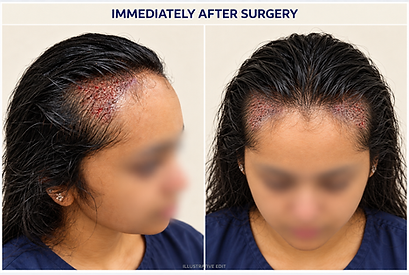
Large temple recession
Concern: Receding temples, wished to keep existing length
Surgery Day: Existing hair kept at full length, no recipient shave
Treatment: Unshaven FUE, 1400 grafts
Planning: returned to client-facing work, style unchanged
Result: photographed at 12 months


Hairline lowering
Concern: Receding hairline, wished to keep existing length.
Surgery Day: Existing hair kept at full length, no recipient shave
Treatment: Unshaven FUE 1730 grafts
Planning: returned to client-facing work, style unchanged
Result: 10 months after surgery
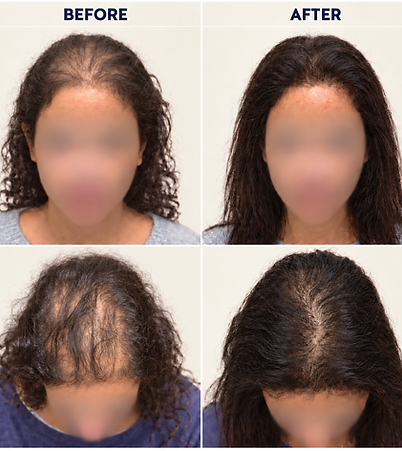

Widened parting
Concern: receding frontal and mid-section, grade 4, wished to keep existing length
Surgery Day: Existing hair kept at full length, no recipient shave
Treatment: Unshaven FUE, 2,500 grafts
Planning: returned to client-facing work, style unchanged
Result: stage photographed at 11 months
SUITABILITY
Am I Suitable for Unshaven FUE?
Unshaven FUE is not right for everyone. Being clear about its limits is part of planning it well.
Often well suited
+ Defined areas such as the hairline or temples
+ Small to moderate graft requirements
+ Medium or longer hair that can cover the treated areas
+ Good donor density and stable hair loss
+ Patients who need to return to work or social life with
minimal change
May need another approach
– Extensive hair loss needing large graft numbers in one session
– Very short hairstyles with little length to conceal treated areas
– Crown treatment, where longer hair covers less naturally
– Diffuse thinning or hair loss that is still progressing rapidly
– Limited donor density
QUESTIONS
Unshaven FUE: Frequently Asked Questions
The questions patients ask most before choosing Unshaven FUE. If yours is not here, ask Dr Feyroza directly.
01 Is Unshaven FUE the same as Long Hair FUE?
No. Long Hair FUE is a separate technique in which the transplanted grafts keep their full hair length. With Unshaven FUE, your existing hair is kept long around the treated areas and the donor area is prepared discreetly, while the grafts themselves are trimmed before placement.
02 How many grafts can be transplanted without shaving?
It depends on donor density, hair characteristics and time. Fully unshaven sessions are generally smaller, while concealed-shave approaches allow more. The unshaven cases on this page involved 2,305 and 2,700 grafts.
03 Is Unshaven FUE suitable for the crown?
Sometimes, but it is usually less discreet there. Longer hair does not fall over the crown as easily, and crown work often needs larger graft numbers. It is assessed individually.
04 Does Unshaven FUE cost more or take longer?
Usually both. Extracting and placing grafts between existing hairs is slower and more demanding, so a session takes longer or covers fewer grafts than standard FUE. Your fee is based on the approach and graft number agreed at consultation. See pricing for guidance.
NEXT STEP
Find Out Whether Unshaven FUE is Suitable for You
Send photographs of your hair or arrange a consultation with Dr Feyroza Mustaeva.
You will discuss your hair loss, hairstyle, donor area, graft requirements and how discreetly your treatment could be planned.
In-person consultations in Marylebone · Virtual consultations available