
HAIR TRANSPLANT TECHNIQUES
Hair Transplant Techniques:
How We Plan Your FUE Procedure
Follicular Unit Excision (FUE) is not defined by one instrument or implantation method. A carefully planned procedure brings together donor assessment, individual follicular-unit extraction, recipient-site design and controlled graft placement.
Dr Feyroza Mustaeva selects the surgical approach according to your hair characteristics, pattern of hair loss, donor capacity and the area being restored—not from a standardised treatment package.

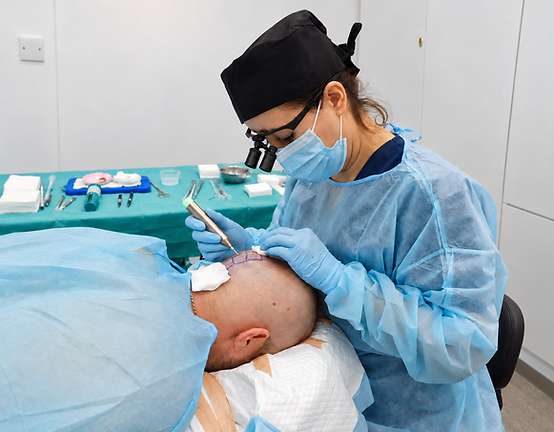
Dr Mustaeva carrying out recipient-site planning
WHAT FUE MEANS
PLACEMENT METHODS
SHAVING OPTIONS
THE SURGICAL STAGES
SUITABILITY
ONE PROCEDURE - SEVERAL DECISIONS
Clinical Planning Beyond the Instrument
The technique is built around four connected stages rather than selected as a pre-set package. Each stage is planned as a part of one procedure
Donor assessment
Density, hair calibre and the safe extraction area are evaluated.
Follicular extraction
Suitable follicular units are removed individually using a small punch.
Recipient planning
Distribution, angle and direction are planned for the area being treated.
Graft placement
Follicles are introduced using the placement approach selected for the case.
UNDERSTANDING THE DIFFERENCE
Extraction and Implantation are Separate Decisions
A hair transplant involves carefully removing follicular units from the donor area and placing them into recipient sites.
“FUE” describes how grafts are extracted. “DHI” commonly describes implantation with a pen implanter. They may be used together.
UNDERSTANDING THE TECHNUQUE
What FUE Means — From Extraction to Placement
FUE describes how individual follicular units are removed from the donor area. The method used to place those grafts is a separate clinical decision made according to the recipient area and the wider surgical plan.
What Does FUE Mean?
Follicular Unit Excision, or FUE, describes the way individual follicular units are removed from the donor area. It does not, by itself, describe how those grafts are subsequently implanted.
Small circular extraction points are distributed throughout an appropriate donor zone rather than creating the linear scar associated with strip surgery. These points normally become less noticeable as they heal, although FUE is not scar-free and suitability depends on donor density, hair characteristics and healing.
The extracted follicles are then inspected, organised and preserved until implantation.
KEY CONSIDERATIONS
✓ Donor density, calibre and miniaturisation
✓ Safe and even extraction distribution
✓ Graft requirements balanced against donor supply
✓ Hair characteristics and individual healing
Dr Feyroza doing graft extraction
FUE EXTRACTION PLANNING
Why Donor Management Matters
Individual follicular units are removed in a carefully distributed pattern, taking account of donor density, hair characteristics and the number of grafts required. The aim is to preserve a balanced appearance throughout the donor area.
FUE Implanter Pen
Implanter pens can be used to place prepared grafts during an FUE procedure. Each graft is loaded into the pen and introduced into the recipient area with control over depth, angle and direction.
This may be useful in selected areas, particularly where grafts are placed among existing hair or where close directional control is required. The pen itself does not determine how natural a result will appear; design, graft selection, handling and placement remain important.
MAY BE CONSIDERED FOR
✓ Selected hairline and frontal zones
✓ Placement between existing hairs
✓ Eyebrow or beard work requiring directional control
✓ Smaller or highly detailed recipient areas
✓ Use alongside pre-made sites in a hybrid plan

Dr Feyroza doing graft implantation using implanter pen
PLACEMENT CONTROL
What the Implanter Pen Helps Control
✓ Depth — controlled introduction of each graft
✓ Angle and direction — aligned with the planned growth pattern
✓ Detailed placement — useful around existing hair and selected smaller areas
The Distinction
FUE is the extraction method.
An implanter pen is one option for graft placement. They are not competing procedures and may form part of the same individually planned treatment.
FUE Sapphire Blade Incisions and Graft Placement
Two carefully planned stages connect recipient-site design with the individual placement of follicular-unit grafts.
Stage 01 — Recipient-site creation
Stage 02 — Graft placement
*This short video shows recipient-site incisions during hair transplant surgery. Viewer discretion is advised if you are sensitive to surgical imagery.
Sapphire-Blade Incisions
Fine recipient sites are created using appropriately selected sapphire blades. Their angle, direction and distribution are planned around the patient’s existing hair, scalp characteristics, graft requirements and intended result.
Dr Feyroza Mustaeva creating recipient-site incisions with a sapphire blade during an FUE hair transplant procedure. The patient’s identity is obscured.

This photograph shows graft placement during hair transplant surgery. The patient’s face is not visible
Individual Graft Placement
Once the recipient sites have been prepared, the follicular-unit grafts are placed individually using fine forceps. Placement follows the planned distribution while taking account of graft size, existing hair and the intended visual density.
Follicular-unit grafts being placed individually into the prepared recipient sites using fine forceps.
Selected Through Clinical Assessment
This approach may be selected when it provides appropriate control over recipient-site design and graft distribution. The decision follows assessment of the treatment area, existing hair, graft requirements and planned density.
Direction & Angle
↘
Sites are created to follow the intended direction and angle of natural hair growth.
Incision Distribution
▦
Distribution is planned around the design, existing hair and available graft supply.
Planned Graft Placement
⊙
Prepared grafts are placed carefully into the recipient sites using fine forceps.
FOLLICULAR UNIT EXTRACTION
Shaven vs Unshaven FUE
The extent of shaving is planned around the donor area, the number of grafts required, hair length and the patient’s individual priorities.


Shaven FUE
Both the donor and recipient areas are shaved. This provides clear access during extraction, recipient-site creation and graft placement.
Unshaven FUE
Selected donor hairs are trimmed discreetly while surrounding hair remains longer, helping to conceal the treated donor area.
✓ Clear visibility of the donor area
✓ Suitable for varied graft requirements
✓ Hair begins growing again immediately
✓ Less visible change to the hairstyle
✓ Considered for selected suitable patients
✓ Planned according to graft requirements
BEFORE YOUR PROCEDURE
The Right Technique Begins with the Right Assessment
01 Assessing Your Suitability
A hair transplant should not begin with selecting a technique. Dr Feyroza first assesses your pattern of hair loss, donor supply, recipient area, hair characteristics, scalp health and the possibility of future hair loss. Where appropriate, trichoscopy provides additional clinical information.
02 Selecting the Right Technique
This assessment helps determine whether surgery is suitable and whether Shaven FUE, Unshaven FUE or a particular implantation approach is most appropriate. It also supports realistic graft planning, careful use of the donor area and a plan designed around your long-term needs.