
SURGEON-LED HAIR & SCALP ASSESSMENT
Hair Transplant Consultation & Surgical Assessment
Your hair transplant consultation with Dr Feyroza Mustaeva brings together your medical history, hair and scalp examination, and donor assessment to determine surgical suitability and guide bespoke surgical planning.

Dr Feyroza Mustaeva performing trichoscopy as part of a comprehensive hair transplant surgical assessment.
HAIR & SCALP
Calibre
Density
Scalp Health
Miniaturisation

A COMPREHENSIVE HAIR & SCALP ASSESSMENT
Looking Beyond Visible Hair Loss
HAIR-LOSS HISTORY
Onset & duration
Pattern & progression
Shedding
Family history

WIDER FACTORS
Lifestyle & stress
Diet & nutrition
Medication
Relevant medical history

Your assessment considers the characteristics of the hair and scalp alongside the history and progression of hair loss, family history, lifestyle, nutrition, relevant medical factors and previous treatments.
Where appropriate, trichoscopy provides a magnified view that can reveal features not readily appreciated by visual examination alone.
Hair loss is not always explained by what is immediately visible.
A meaningful assessment considers the hair and scalp alongside the pattern and progression of hair loss, your history and other factors that may influence hair health.
Each finding adds context.
No single observation determines the diagnosis or treatment plan on its own.
TRICHOSCOPY
Hair & Scalp Under Magnification
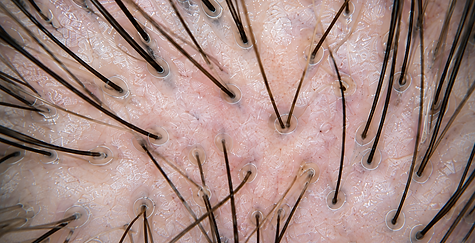
Magnified view illustrating variation in hair-shaft calibre, follicular openings and the surrounding scalp.

Frontal / Thinning Area
Finer hairs and variation in calibre within lower-density areas.

Donor Area
Magnified view of follicular units, hair calibre and donor density.
*Trichoscopy images shown for illustrative purposes
Looking Beyond What the Eye Can See
Trichoscopy provides a magnified view of the hair and scalp, allowing features that may not be readily appreciated during visual examination alone to be examined more closely.
Interpreted alongside your history and clinical examination, it can provide valuable information about hair calibre, miniaturisation, follicular characteristics, scalp health and the potential donor area.
HAIR CALIBRE
Assesses variation in hair-shaft diameter and the characteristics of existing hair.
FOLLICULAR UNITS
Examines the number and distribution of hairs within individual follicular units.
MINIATURISATION
Identifies finer, miniaturised hairs that may indicate progressive follicular change.
SCALP & DONOR FEATURES
Assesses scalp condition and hair characteristics within potential donor areas.
Trichoscopy does not stand alone. Its value comes from interpreting what we see alongside your history and clinical examination.
CLINICAL EXAMINATION
From History to Hands-On Assessment
Your hair history helps us understand what you have noticed and how things may have changed. A physical examination allows us to look more closely at what is happening now.
Active Shedding & Hair Pull Test

Why we check it
To see whether increased hair shedding is happening now, rather than relying only on how the hair looks.
What it tells us
If hairs release easily during a gentle pull test, it can support the presence of active shedding when considered with your history and trichoscopy.
Before the surgery
If active shedding is present, we first aim to optimise hair health and address possible contributing factors, such as iron or nutritional deficiencies, hormonal changes or stress. Surgery can then be considered once the hair and scalp are in a healthier, more stable condition.
Hair & Scalp Examination

Why we check it
To assess the health of the scalp and the quality of the existing hair in both the thinning and donor areas.
What it tells us
We look for reduced density, thinning hairs, irritation, scaling, inflammation, scarring or other changes that could affect hair growth or transplantation.
Before surgery
Scalp conditions should be treated first. Reduced density or miniaturisation may benefit from minoxidil, DHT-blocking therapy, PRP or other treatments to optimise and stabilise the hair.
Inflammation or dandruff may require treatment prior the surgery.
Scalp Mobility & Laxity

Why we check it
To assess how easily the scalp tissue moves and stretches in the donor and treatment areas.
What it tells us
A very tight, scarred or less mobile scalp can make tissue handling more difficult and may influence surgical planning.
Before surgery
If the scalp feels tight, massage or gentle softening techniques may help improve flexibility before surgery. Scarring from previous hair transplant surgery, including linear FUT scars, may also require assessment and optimisation before further transplantation
AT HOME — WHAT YOU MAY NOTICE
Increased hair on your pillow, in the shower or during brushing can be useful to mention at your consultation. You can also gently check whether hairs release easily from different areas of the scalp, although this should not be used to diagnose the cause of hair loss on its own.
THE WIDER PICTURE
Your Hair Doesn't Exist in Isolation
A few wider factors can influence hair growth and shedding. Understanding them helps us identify anything worth optimising before or alongside your treatment.

Nutrition & Hair Health
Diet and nutritional deficiencies can affect hair quality and shedding. Where appropriate, nutrition or supplementation may be optimised.

Health, Hormones & Lifestyle
Medication, hormonal changes, illness, stress and lifestyle may sometimes contribute to changes in the hair.

When We Need to Look Further
Sometimes, blood tests or further assessment may help identify factors affecting hair growth that can be addressed before treatment.
Once these findings are considered together, the next question is whether
hair transplant surgery is appropriate for you — and how it should be planned.

SURGICAL SUITABILITY
Is Hair Transplant Surgery Right for You?
Hair transplant suitability is individual. We consider your pattern of hair loss, donor hair, scalp health, age and likely future changes to understand whether surgery is appropriate for you.
Just as importantly, we consider what can be achieved naturally and safely with the donor hair available — both now and over the longer term.

WHAT WE CONSIDER BEFORE RECOMMENDING SURGERY

Age, Pattern & Stability
Age is considered alongside the pattern and progression of hair loss. In younger patients especially, we look carefully at whether the pattern is established and how it may change over time.

Scalp Health & Scarring
The scalp should be healthy before surgery. Previous hair transplants, scarring, including linear FUT scars, and areas of reduced scalp mobility are assessed individually when planning treatment.

Donor Hair Reserve
Donor density, quality and distribution help determine how many grafts can be used safely while preserving enough donor hair for possible future needs.

Future Hair Loss & Genetics
Family history, the pattern of progression and signs of miniaturisation help us consider the risk of future hair loss and plan beyond the hair you have today.

Hair Characteristics
Hair calibre, thickness, curl and texture, as well as the contrast between hair and scalp colour, can influence coverage and the number of grafts that may be needed.

Your Goals & Expectations
Hairline position, density and coverage need to be achievable with the donor hair available. We aim for a result that looks natural now while remaining appropriate if further hair loss occurs.
BRINGING IT ALL TOGETHER
Suitability Is a Clinical Decision, Not a Checklist
Suitability for hair transplant surgery isn't determined by one measurement alone. We bring together your hair-loss pattern, donor hair, scalp health, hair characteristics and longer-term risk of further loss to decide whether surgery is appropriate — and how it should be planned.

SUITABLE FOR SURGERY
Your assessment supports moving forward to personalised surgical planning.

OPTIMISE BEFORE SURGERY
Hair or scalp health may need treatment or stabilisation before proceeding.

FURTHER ASSESSMENT
Further tests or specialist review may be appropriate before a surgical decision