
SURGEON-LED HAIR RESTORATION
Afro Hair Transplant
For Men And Women
Explore restoration of your hairline, temples and edges with Dr Feyroza Mustaeva. Your consultation starts with the area you want to change, an assessment of your scalp and a clear discussion of what your donor hair can support.
From receding corners to thinning edges or crown coverage, your plan considers your existing hair, facial proportions and future hair loss.

For men and women • Individual surgical planning • Hairline and donor assessment

SPECIALIST PLANNING FOR AFRO HAIR
Why Afro Hair Requires Specialist Expertise
Afro-textured hair has unique characteristics that require specialised planning and surgical expertise. The natural curl pattern provides excellent visual density and coverage, but it also makes transplantation more technically demanding than in straight hair types. With the right approach, Afro hair transplantation can achieve natural-looking, long-lasting results tailored to your individual goals.

Our personalised treatment plans are designed to maximise donor hair, preserve natural growth patterns, and create results that complement your facial features and hair characteristics.
YOUR RESTORATION GOALS
Which Area Would You Like To Restore?
Start with the area you would like to change. Your assessment will establish whether transplantation is appropriate and how much restoration your donor hair can support.


Illustrative imagery. Suitability is assessed individually.

HAIRLINE · TEMPLES · CROWN
Afro Hair Transplant For Men
A Considered Hairline - From The Front And In Profile
A receding hairline can change more than the height of your forehead. Loss at the corners can interrupt the connection between your frontal hairline and temples, while thinning further back can affect the overall balance of your hair.
Your consultation examines these areas together. The aim is to identify where transplantation could provide worthwhile improvement and design a hairline that suits your face, age and longer-term hair loss pattern.
Rebuild selected areas of frontal recession.
Address temple gaps and the transition into existing hair.
Plan crown coverage alongside donor preservation.


EDGES · SHAPE · BALANCE
Afro Hair Transplant For Women
Restore The Connection Between Your Hairline And Temples
For some women, the concern is a gap at the corners. For others, thinning extends across the frontal edge or has changed the shape of the hairline.
Your consultation considers where the hair has been lost, the condition of your scalp and what your donor hair can support. Together, we discuss how restoration could reconnect the frontal hairline and temples, improve balance and blend with your existing hair.
Temples & Corners: Assess gaps where the frontal edge meets the sides.
Frontal Edge Restoration: discuss areas of established hair loss.
Hairline Reshaping: explore shape, balance and selective lowering.

.png)
ASSESS THE CAUSE FIRST
Traction Alopecia And Hair Transplant Suitability
Repeated tension from tight hairstyles can cause traction alopecia. Early assessment matters because prolonged traction can lead to permanent hair loss.
If gaps remain after styling habits have changed, a consultation can explore whether hair restoration is appropriate. We first assess the diagnosis, the affected scalp and your available donor hair.
Not every area of thinning is caused by traction, and not every case is suitable for surgery. Treatment or specialist scalp assessment may need to come before transplant planning.
Your plan should also address how to reduce repeated tension on the affected area.
Benefits of Afro Hair Transplantation
Afro hair restoration brings together the visual coverage of natural curls, individually planned hairline design and a longer-term approach to maintaining your result.

Exceptional Natural Density
The natural curl pattern of Afro hair creates excellent visual coverage. The number of grafts needed depends on your hair characteristics, restoration area and donor availability.

Personalised Hairline Design
Every hairline is carefully designed to suit your facial proportions, age, ethnicity, and personal preferences for the most natural-looking outcome.

Long-Lasting Results
Transplanted follicles can continue to grow naturally for long-lasting coverage. Existing hair may continue to thin, so future hair loss is considered in your plan.
INDIVIDUAL SURGICAL PLANNING
My Approach To Afro Hair Restoration

Your Goals
We discuss your concerns and what you would like to achieve.

Scalp & Donor Assessment
Your scalp, hair characteristics and donor supply are assessed.

Hairline Design
We design a hairline and restoration plan to suit your features.

Surgical Planning
Your treatment is planned with careful attention to detail.

Aftercare And Follow-Up
You receive personalised aftercare and ongoing support.

ⓘ Is Hair Transplant Surgery Suitable For You?
Your consultation includes an assessment of your scalp, the cause of your hair loss and your donor hair—to establish whether surgery is appropriate and whether an unshaven approach could suit you. Some scalp conditions may need further investigation or treatment first.
Not every area of hair loss is suitable for transplantation. The cause of your hair loss and any underlying scalp condition may mean that further investigation or treatment is needed first. I assess surgical suitability before considering whether an unshaven approach could work for you.
YOUR HAIRLINE DESIGN BEFORE SURGERY
Planning Your Hairline, Preserving Your Individual Style

Unshaven Afro Hairline Design For Men
For men who prefer to retain their existing hairstyle, I assess whether an unshaven or partially shaved approach can suit the planned restoration. We discuss the hairline, temple corners or thinning areas alongside donor access, curl pattern and hair length. I explain which areas can remain long and where limited trimming may be needed.
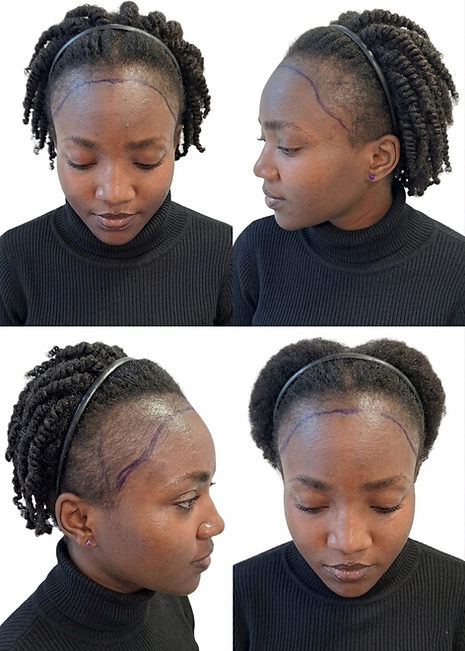
Unshaven Afro Hairline Design For Women
For women seeking to restore their hairline or fill temple gaps, retaining surrounding hair can be an important part of the plan. I assess your donor hair, curl pattern and usual hairstyle before recommending an unshaven or partially shaved approach. We agree the restoration design and discuss any limited trimming, including whether it can be covered by your existing hair.
FROM YOUR RESTORATION PLAN TO SURGERY
Working With Your Natural Curl, From Root To Placement
The area you want to restore guides the design. Your donor hair helps determine how that design can be achieved. For Afro-textured hair, I consider both the curl visible above the scalp and the follicle’s curvature beneath it—then carry that assessment through extraction and implantation.

01 / EXTRACTION
Following The Follicle Beneath The Scalp
The visible curl tells only part of the story. During extraction, I adapt the punch positioning and movement to the characteristics of your follicles, working carefully to release each graft while preserving the surrounding donor area.

02 / IMPLANTATION
Turning The Design Into Individual Placements
I place each graft according to the agreed design, considering your existing hair direction, angle and spacing. At the hairline, I create a gradual transition; further behind it, I focus on coverage and distribution.
EARLY HEALING TO GRADUAL GROWTH
Immediately After Unshaven Afro Hair Transplant
Scalp healing comes first. Hair growth follows gradually, with individual timing varying from patient to patient.
Immediately After The Procedure

Men — Immediately After Unshaven Hair Transplant
The close-up views show the grafts along the frontal hairline and corners, with the existing curls retained on top. The dressing covers the prepared donor area at the back of the head.

Women — Immediately After Unshaven Hair Transplant
The close-up views show how the grafts follow the planned hairline, while the surrounding hair and short twists remain in place. This is the immediate postoperative appearance, before healing and new growth.
These photographs document the treated areas at the end of surgery, before healing and new growth.

Your Hair Growth Timeline
2–8 Weeks
Post-Transplant Shedding
Transplanted hairs often shed before new growth begins.
Around 4 Months
Early Hair Growth
New hairs usually begin to appear around four months after surgery. Early growth develops gradually and may look uneven.
6–9 Months
Developing Coverage
Coverage becomes more noticeable as the transplanted hair grows and thickens. Progress varies between patients
12–18 Months
Maturing Results
Hair transplant results continue to mature, with the fuller appearance becoming clearer over time. Timing varies by patient and treated area.
Your individual aftercare instructions take priority over this general timeline.


COMMON QUESTIONS
Afro Hair Transplant Questions
YOUR NEXT STEP
Restore Your Curls With Confidence
Every hair type deserves a personalised approach. At HairMD London, we combine specialised expertise with tailored treatment planning to achieve natural-looking, long-lasting results for Afro-textured hair.
Book your consultation today and take the first step towards restoring your hair, confidence, and peace of mind.
Tell us which area you would like to restore and what you would like to change.
Discuss Your Hair Restoration With Dr Feyroza