
FUE · UNSHAVEN FUE · IMPLANTER PEN
Hair Transplant for Men in London
Individually planned hair restoration for receding hairlines, crown thinning and reduced density, led by Dr Feyroza Mustaeva in Marylebone.

Same-Day Discharge
Local Anaesthetic
No Linear Scar
Results: 12–18 Months
YOUR CONCERNS
Areas Men Commonly Want to Restore
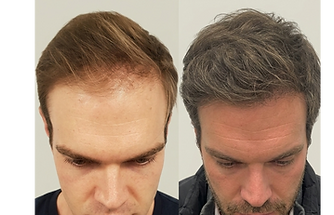
Hairline & Temples
Restore definition with a natural, age-appropriate hairline.

Frontal & Mid-Scalp
Improve density while blending with existing hair.

Crown Restoration
Restore coverage while recreating the natural crown pattern.
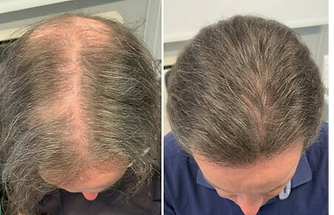
Extensive Thinning
Plan wider coverage while using donor hair carefully.
What Would You Like to Address?
SELECTED OUTCOMES
Results Planned Around the Individual
Male hair loss can affect different areas and progress in different ways. Every treatment plan considers the patient’s pattern of hair loss, donor capacity and long-term progression. Explore the areas most commonly considered for surgical restoration.

Case 1- Hairline
Natural Hairline Restoration
2,485 grafts · FUE · 12-month result
Hairline and temple restoration planned to complement the patient’s facial proportions

Case 2 — Frontal density
Frontal & Mid-Scalp Restoration
2,600 grafts · FUE · 14-month result
Density distributed through the frontal and mid-scalp while preserving donor reserves.

Case 3 — Crown
Crown Restoration
2,350 grafts · FUE · 12-month result
Grafts positioned around the natural direction and spiral pattern of the crown.
*Individual results vary. Graft requirements and treatment suitability are assessed during consultation
HAIRLINE DESIGN
The Detail Behind a Natural Hairline

Pre-operative hairline design
Mature 12-month result
The blue line is not a standard shape applied to every patient. Its position and irregularity are planned to complement the face, existing hair and likely future progression.
Position
Balanced with facial proportions and age.
Shape
Adapted to existing recession and temple structure.
Irregularity
A softer leading edge rather than an artificial straight line.
INDIVIDUAL TREATMENT PLANNING
Designed Around You, Not a Template
A hair transplant should not begin with a standard hairline or a predetermined graft package. Planning considers your facial proportions, pattern of hair loss, existing density, donor capacity and how your hair may change over time.

Hairline & Temples
The height, shape and softness of the hairline are planned around your facial proportions, age and existing hair, while preserving donor capacity for possible future loss.

Crown
The crown requires a different approach because of its natural spiral and larger surface area. Coverage must be balanced against donor availability and, in some patients, may be prioritised or treated in stages.

Frontal & Mid-Scalp
Grafts are distributed where they can provide the greatest visual improvement, while integrating naturally with existing hair and preserving an appropriate long-term donor reserve.

More Extensive or Diffuse Thinning
When hair loss affects several areas, the first decision is whether surgery is appropriate. Existing hair, likely progression and donor limitations may require conservative planning, medical treatment or a staged approach.

Planning the Whole Picture
Your consultation is not about selecting a package. It is about determining whether surgery is suitable, which areas should be prioritised and how your donor hair can be used responsibly over the long term.
DISCUSS YOUR PRIORITIES
TREATMENT OPTIONS
An Approach Selected for Your Hair and Priorities
Standard FUE
For wider areas where coverage and graft distribution are the priorities.
FUE with Implanter-Pen Placement
For detailed control of graft angle, direction and depth, particularly around the hairline.
A more discreet option for selected patients who prefer to preserve surrounding hair length.

UNDERSTANDING MALE HAIR LOSS
Why Does Male Hair Loss Develop?
The most common cause of hair loss in men is androgenetic alopecia. It develops through a combination of genetic susceptibility and sensitivity to dihydrotestosterone (DHT), a hormone derived from testosterone.
In susceptible follicles, DHT gradually shortens the active growth phase. Over time, affected hairs become finer, shorter and less visible—a process known as miniaturisation. This commonly produces recession at the temples, thinning through the frontal scalp or progressive loss at the crown.
A hair transplant redistributes suitable donor follicles, but it does not prevent untreated existing hair from continuing to thin. That is why likely progression forms part of treatment planning.
A Result That Still Feels Like You

The aim is not to create an obvious transplanted appearance, but a result that sits naturally within your existing hair and facial features.
Is Hair Transplant Surgery Right for You?
Suitability is never decided by hair loss alone. A careful assessment considers four areas before surgery is recommended.
Hair-loss pattern
The cause, extent and progression of your hair loss.

Donor strength
Available density and the long-term donor reserve.

Scalp health
Scalp condition, inflammation and diagnostic clarity.

Medical suitability
Medical history, healing factors and realistic goals.

Further assessment may be advised where hair loss is rapidly progressing or diffuse, the diagnosis is uncertain, scalp inflammation is present, or donor availability is limited.